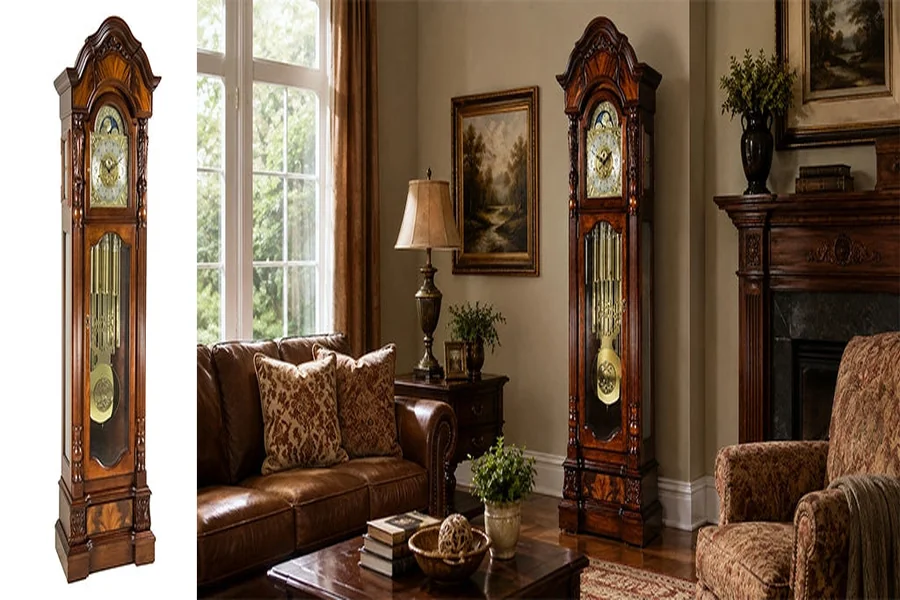
Trend grandfather clocks are vintage floor clocks known for traditional wooden cases, mechanical movements, pendulums and classic home décor appeal. Many people searching for these clocks want to learn about the Trend Clock Company, identify an inherited clock or understand whether an older model may have collectible value.
Interest in trend grandfather clocks often comes from owners who already have one in their family. Others find them at estate sales, antique shops, auctions or online marketplaces. Since the original Trend brand is no longer producing clocks, buyers are generally looking at vintage or pre-owned examples.
The Trend Clock Company was founded in 1937 and produced several styles of clocks before the business became associated with Sligh Furniture. That history gives trend grandfather clocks a recognizable place among American vintage floor clocks.
Featured Answer: What Are Trend Grandfather Clocks?
Trend grandfather clocks are floor-standing clocks produced under the Trend Clock Company name and later through its association with Sligh Furniture. They commonly feature wooden cabinets, pendulums, weights, mechanical movements and traditional clock faces.
Many examples of trend grandfather clocks were designed as both timepieces and furniture. Today, they are usually purchased second-hand because production under the Trend name ended decades ago.
Trend Grandfather Clocks Quick Facts
| Feature | Details | Example |
| Brand | Trend Clock Company | Vintage American clock brand |
| Founded | 1937 | United States |
| Clock Type | Floor clock | Grandfather clock |
| Common Materials | Wood and metal components | Oak, walnut or cherry-style finishes |
| Movement | Mechanical or other period movements | German-supplied movements on some models |
| Major Brand Change | Acquired by Sligh Furniture | 1968 |
| Later Branding | Trend Clocks by Sligh | Seen on some models |
| Current Production | Discontinued | Mainly found pre-owned |
| Main Keyword | trend grandfather clocks | Vintage floor clocks |
History of Trend Grandfather Clocks
Understanding the company behind trend grandfather clocks can make it easier to identify an older piece.
The Trend Clock Company was founded by Gerritt Van Tamelen in 1937. Early production included clocks using movements supplied by outside manufacturers. Over time, the company expanded its range of clock designs.
Trend introduced smaller grandmother-style clocks in the late 1940s. Mechanical movement suppliers also changed over the years. Schatz became an important supplier during the 1950s according to historical accounts of the company.
The history of trend grandfather clocks changed significantly in 1968 when the company was sold to Sligh Furniture Company. Trend-branded clocks continued afterward and some clocks were labeled “Trend Clocks by Sligh.”
This history means that two trend grandfather clocks can look similar while coming from different periods in the brand’s development.
Why Trend Grandfather Clocks Are Still Popular
Vintage furniture and mechanical clocks continue to attract people who prefer traditional home décor. Trend grandfather clocks combine both interests in one large decorative piece.
Their appeal can come from several factors:
- Traditional floor-clock design
- Visible pendulum movement
- Wooden furniture-style cabinets
- Mechanical clock components
- Family or sentimental history
- Vintage home décor
- Collectible interest
- Chime mechanisms on many examples
For some owners, trend grandfather clocks are primarily decorative. For others, maintaining the mechanical movement and chimes is a major part of owning the clock.
Common Features of Trend Grandfather Clocks
Individual models vary, but many trend grandfather clocks share recognizable characteristics.
Wooden Cabinet
A tall wooden cabinet is one of the most visible characteristics of trend grandfather clocks.
Different models may have different wood species, veneers, stains and finishes. Some cases are relatively simple while others include columns, arches, decorative trim or detailed door panels.
One auction example of a Trend clock by Sligh used a mahogany-finished case with columns, a broken-arch pediment, moon dial and visible pendulum.
Pendulum
The pendulum is a central part of the traditional appearance of trend grandfather clocks.
In mechanical clocks, the pendulum works with the movement to regulate timekeeping. The exact design can vary. Decorative brass-colored pendulums are common on many traditional floor clocks.
Weights
Many mechanical trend grandfather clocks use hanging weights.
The weights provide energy for functions such as timekeeping and chimes. Depending on the movement, several weights may be used for different functions.
Owners should avoid moving weights or internal parts without understanding how the specific clock operates.
Clock Dial
The dial is another major design feature.
Some trend grandfather clocks use Roman numerals while others may have Arabic numerals or decorative markers. Moon dials and ornamental metal details can also appear on certain models.
Chimes
Many people are interested in trend grandfather clocks because of their chime functions.
The exact chime configuration depends on the movement installed in the clock. Older clocks should be inspected before assuming that every chime function is operating correctly.
Trend Grandfather Clocks by Sligh
Some of the most frequently encountered trend grandfather clocks have a connection with Sligh Furniture.
Sligh purchased Trend in 1968. The Trend name continued to be used on clocks for a period after that acquisition.
As a result, owners may see markings such as:
- Trend
- Trend Clock Company
- Trend Clocks
- Trend by Sligh
- Trend Clocks by Sligh
A label can provide useful clues when researching trend grandfather clocks, but the label should be considered together with model numbers, movement numbers and other identifying information.
How to Identify Trend Grandfather Clocks
If you already own one of these clocks, identification usually begins with the markings.
When researching trend grandfather clocks, inspect several areas carefully.
Check the Dial
Look for the Trend name printed or applied to the clock dial.
The company used Trend branding on many clocks. This is often the first visible clue that the clock belongs to the brand.
Check Inside the Cabinet
Open accessible doors carefully and inspect labels.
A trend grandfather clocks identification label may include information such as:
- Style number
- Model number
- Movement number
- Pack number
- Manufacturer name
- Sligh branding
- Movement manufacturer
- Other production markings
Do not remove old labels because they can be useful for later identification.
Inspect the Movement
Movement markings can provide additional information about trend grandfather clocks.
Some Trend clocks used imported mechanical movements, including German-made movements. Movement numbers may help a clock specialist identify parts or estimate the period in which a clock was produced.
Photograph Important Details
Take clear photos of:
- Full clock
- Dial
- Pendulum
- Weights
- Movement
- Labels
- Model numbers
- Decorative details
These photographs can make researching trend grandfather clocks much easier.
Trend Grandfather Clocks Value
There is no single fixed value for trend grandfather clocks.
Price can depend on the model, age, cabinet condition, movement condition, originality and local demand.
A clock that looks attractive but does not run may be worth less than a similar working clock. However, an unusual model or exceptionally preserved example may attract more collector interest.
When estimating the value of trend grandfather clocks, consider:
| Factor | Why It Matters |
| Condition | Damage can reduce buyer interest |
| Movement | Working condition is important |
| Cabinet | Wood condition affects appearance |
| Originality | Replaced parts may affect collector interest |
| Model | Some versions may be less common |
| Chimes | Working chimes may improve appeal |
| Local demand | Large clocks can be difficult to ship |
| Documentation | Original paperwork may help identification |
Past asking prices should not automatically be treated as current market value. Actual sale prices can be different.
How to Estimate the Value of Trend Grandfather Clocks
Start by identifying the exact model before trying to estimate value.
Two trend grandfather clocks may have very different resale prices even when they are approximately the same age.
Follow these steps:
- Find the model or style number.
- Find the movement number.
- Check the manufacturer label.
- Photograph the cabinet.
- Test the clock carefully.
- Record any damage.
- Search for comparable sold examples.
- Consider a professional appraisal for valuable pieces.
For trend grandfather clocks with family history or unusual features, an experienced clock specialist may provide better information than a general online price estimate.
Trend Grandfather Clocks vs Modern Grandfather Clocks
Vintage and modern floor clocks can serve similar decorative purposes but are different in several ways.
| Feature | Trend Grandfather Clocks | Modern Grandfather Clocks |
| Production | Vintage/discontinued | Currently produced models available |
| Brand History | Historic Trend brand | Current manufacturers |
| Buying Market | Mostly second-hand | New and used |
| Movement | Depends on original model | Mechanical or quartz |
| Condition | Varies by age | New examples usually unused |
| Parts | May require specialist sourcing | Parts may be easier to source |
| Collector Interest | Can appeal to vintage buyers | Usually décor-focused |
People interested specifically in trend grandfather clocks usually value the brand history and older construction as much as the clock’s practical function.
Where to Buy Trend Grandfather Clocks
Since new production has ended, trend grandfather clocks are mainly available through the secondary market.
Possible places include:
- Antique stores
- Estate sales
- Local auctions
- Online auctions
- Furniture resale shops
- Clock dealers
- Classified listings
- Marketplace websites
- Private sellers
Buying locally can be useful because trend grandfather clocks are large, heavy and difficult to ship.
A local purchase also gives buyers a better opportunity to inspect the case, movement and internal components.
What to Check Before Buying Trend Grandfather Clocks
Buying a vintage clock requires more inspection than buying a new decorative object.
Check Whether It Runs
Ask the seller whether the clock currently keeps time.
A seller describing trend grandfather clocks as working should ideally be able to demonstrate that the pendulum runs and the movement continues operating.
Check the Chimes
If the clock has chimes, test them if possible.
Chime problems in trend grandfather clocks may require adjustment, cleaning or professional repair.
Check the Cabinet
Inspect the wood carefully.
Look for:
- Cracks
- Scratches
- Water damage
- Loose trim
- Missing pieces
- Damaged hinges
- Broken glass
- Previous repairs
Cabinet restoration may add considerable expense to trend grandfather clocks.
Check the Weights and Pendulum
Make sure important operating components are present.
Missing weights or a missing pendulum can make restoring trend grandfather clocks more complicated.
Check the Movement
Look for corrosion, damage or signs of poor repair.
If you are unfamiliar with mechanical trend grandfather clocks, having a clock technician inspect the movement may be helpful before an expensive purchase.
Common Buying Mistakes
| Mistake | Why It Matters | Better Approach |
| Buying without checking the model | Identification may be difficult | Record all labels |
| Assuming the clock works | Repairs may be expensive | See it operating |
| Ignoring missing weights | Clock may not function | Check every component |
| Focusing only on appearance | Internal problems may exist | Inspect the movement |
| Assuming asking price equals value | Sellers can set any price | Compare actual sales |
| Forgetting transportation | Large clocks require careful moving | Plan transport first |
| Moving it while assembled incorrectly | Parts can be damaged | Follow safe moving procedures |
Avoiding these mistakes can make shopping for trend grandfather clocks easier.
How to Move Trend Grandfather Clocks
Moving a mechanical floor clock requires care.
Before transporting trend grandfather clocks, loose components normally need to be secured or removed according to the clock’s design.
Common preparation may include:
- Removing the pendulum
- Removing weights
- Securing chains or cables
- Protecting glass panels
- Padding the wooden cabinet
- Keeping hardware labeled
- Transporting the case carefully
Do not simply lay trend grandfather clocks down with the weights and pendulum still hanging inside.
When uncertain, use a professional mover or clock technician.
How to Care for Trend Grandfather Clocks
Regular care can help preserve both appearance and mechanical function.
Keep the Clock Level
Mechanical trend grandfather clocks generally operate best when properly positioned and leveled.
If a clock suddenly stops after being moved, incorrect positioning can be one possible cause.
Keep the Cabinet Clean
Dust wooden surfaces gently.
Avoid applying harsh cleaning products directly to trend grandfather clocks unless you know they are safe for the specific finish.
Avoid Moisture
Excess humidity can affect wood and metal parts.
Place trend grandfather clocks away from damp areas, direct water exposure and locations with severe environmental changes.
Service the Movement
Mechanical clocks can require periodic professional maintenance.
A qualified technician can inspect trend grandfather clocks for worn parts, accumulated dirt, lubrication problems and adjustment issues.
Are Trend Grandfather Clocks Antiques?
Not every old clock qualifies as an antique under every definition.
Most trend grandfather clocks are better described broadly as vintage clocks unless their actual production date meets the age standard being used for the term antique.
Because Trend began production in the 1930s, some of its earliest surviving products are now quite old. However, the company also produced clocks much later.
Always identify the date or production period of trend grandfather clocks before describing a specific example as antique.
Are Trend Grandfather Clocks Collectible?
Yes, some trend grandfather clocks attract interest from people who collect vintage clocks, traditional furniture or products associated with American clockmaking.
Collector interest can be influenced by:
- Age
- Model
- Design
- Condition
- Original movement
- Unusual cabinet
- Brand markings
- Documentation
- Family provenance
However, collectible interest does not automatically mean that all trend grandfather clocks are extremely valuable.
Large clocks can also have a smaller buyer market because storage and transportation are more difficult.
Decorating With Trend Grandfather Clocks
A grandfather clock can become a major visual feature in a room.
Because trend grandfather clocks are tall, they often work well in spaces with enough vertical room.
Possible locations include:
- Entry halls
- Living rooms
- Dining rooms
- Home offices
- Libraries
- Traditional interiors
- Large stairway areas
Measure the space before positioning trend grandfather clocks. Leave enough room to open the front or side access panels when maintenance is needed.
Trend Grandfather Clocks for Vintage Interiors
Traditional furniture has returned to many interior design conversations as homeowners mix older pieces with modern décor.
In this setting, trend grandfather clocks can provide a strong vintage element without requiring an entire room to use the same design period.
A wooden floor clock can work beside:
- Traditional furniture
- Antique cabinets
- Bookshelves
- Neutral walls
- Vintage artwork
- Transitional décor
- Classic rugs
The goal is to give trend grandfather clocks enough visual space rather than surrounding them with too many competing large pieces.
Replacement Parts for Trend Grandfather Clocks
Finding replacement components can take research because the original Trend company no longer produces clocks.
For trend grandfather clocks, the most important information is often the movement manufacturer and movement number rather than simply the Trend name.
Possible replacement needs include:
- Suspension springs
- Pendulum parts
- Weight shells
- Cables
- Chains
- Clock hands
- Bushings
- Movement components
- Door hardware
Before ordering parts for trend grandfather clocks, confirm the exact movement and dimensions.
A part that fits one Trend model may not fit another.
Repairing Trend Grandfather Clocks
Minor adjustment and major repair are not the same thing.
Owners of trend grandfather clocks should avoid dismantling a mechanical movement without the necessary experience.
Professional service may be appropriate when:
- The clock will not stay running
- Chimes stop working
- Weights do not descend correctly
- Cables are damaged
- Chains become jammed
- The pendulum does not swing correctly
- The movement is heavily dirty
- Parts appear bent or broken
A trained clock repairer can inspect trend grandfather clocks and identify whether servicing, adjustment or parts replacement is necessary.
Trend Grandfather Clocks Keyword Variations
| Keyword Variation | Search Intent |
| trend grandfather clocks | General information |
| Trend grandfather clock | Individual clock search |
| Trend clock company grandfather clock | Brand history |
| Trend grandfather clock value | Resale value |
| Trend grandfather clock by Sligh | Sligh-era models |
| Vintage Trend grandfather clock | Vintage buying |
| Trend clock company value | Valuation research |
| Trend grandfather clock parts | Repair and replacement |
| Trend grandfather clock model number | Identification |
| Trend grandfather clock for sale | Purchase intent |
These variations show that searches for trend grandfather clocks can involve history, buying, selling, restoration, identification and valuation.
Final Thoughts
Trend grandfather clocks remain interesting pieces for people who appreciate vintage floor clocks, mechanical timepieces and traditional wooden furniture. The Trend name has a long history that began in the 1930s and later became connected with Sligh Furniture.
Anyone purchasing trend grandfather clocks should focus on the specific clock rather than the brand name alone. Model, condition, movement, cabinet quality, missing parts and service history can all affect ownership and resale value.
If you already own one, start by recording the markings and model information. These details make researching trend grandfather clocks much easier.
Buyers should also remember that vintage mechanical clocks can require maintenance. A beautiful cabinet does not necessarily mean the movement is in excellent condition.
For collectors and homeowners who enjoy traditional timepieces, trend grandfather clocks can still offer an appealing combination of mechanical history, furniture design and classic home décor.
FAQs
What are Trend grandfather clocks?
Trend grandfather clocks are vintage floor clocks made under the Trend Clock Company name and, during later years, through its connection with Sligh Furniture.
Who made Trend grandfather clocks?
The Trend Clock Company originally made trend grandfather clocks. Sligh Furniture acquired Trend in 1968 and continued using the Trend name on clocks for a period afterward.
Are Trend grandfather clocks still made?
No. Original trend grandfather clocks are no longer in current production, so buyers generally find them through vintage and second-hand markets.
Are Trend grandfather clocks valuable?
The value of trend grandfather clocks depends on model, condition, age, movement, originality, cabinet quality and current buyer demand.
How can I identify my Trend grandfather clock?
Look for labels, model numbers, movement numbers and Trend or Sligh markings. These details can help identify trend grandfather clocks more accurately.
Where can I buy Trend grandfather clocks?
You may find trend grandfather clocks at estate sales, antique shops, clock dealers, auctions and online second-hand marketplaces.
Are Trend grandfather clocks by Sligh genuine Trend clocks?
Yes. Some trend grandfather clocks were sold under Trend branding after Sligh acquired the company, and examples may carry Trend-by-Sligh identification.
Do Trend grandfather clocks use German movements?
Some trend grandfather clocks used German-supplied mechanical movements. The exact movement depends on the model and production period.
How often should Trend grandfather clocks be serviced?
The service requirement for trend grandfather clocks depends on the movement, condition and previous maintenance. A professional clock technician can recommend an appropriate schedule.
Can Trend grandfather clocks be repaired?
Yes. Many trend grandfather clocks can be serviced or repaired, although parts availability and repair cost depend on the specific movement and problem.
Should I buy a non-working Trend grandfather clock?
A non-working example may still suit collectors or restoration projects, but trend grandfather clocks with movement problems can require specialist repairs. Check repair costs before buying.
What should I check before moving a Trend grandfather clock?
Before moving trend grandfather clocks, secure or remove the pendulum, weights and other loose components as appropriate for the specific clock.
Are Trend grandfather clocks good for home décor?
Yes. Trend grandfather clocks can work as large traditional décor pieces in living rooms, halls, libraries and other spaces with enough floor and vertical space.
How do I find the model number on Trend grandfather clocks?
Inspect labels inside the cabinet, back panel and movement area. Many trend grandfather clocks have style, model or movement information printed on internal labels.
Are old Trend grandfather clocks collectible?
Some trend grandfather clocks appeal to vintage clock collectors, especially examples with good condition, original components, distinctive designs or clear historical documentation.
1 thought on “Trend Grandfather Clocks: A Complete Guide to History, Value and Buying”