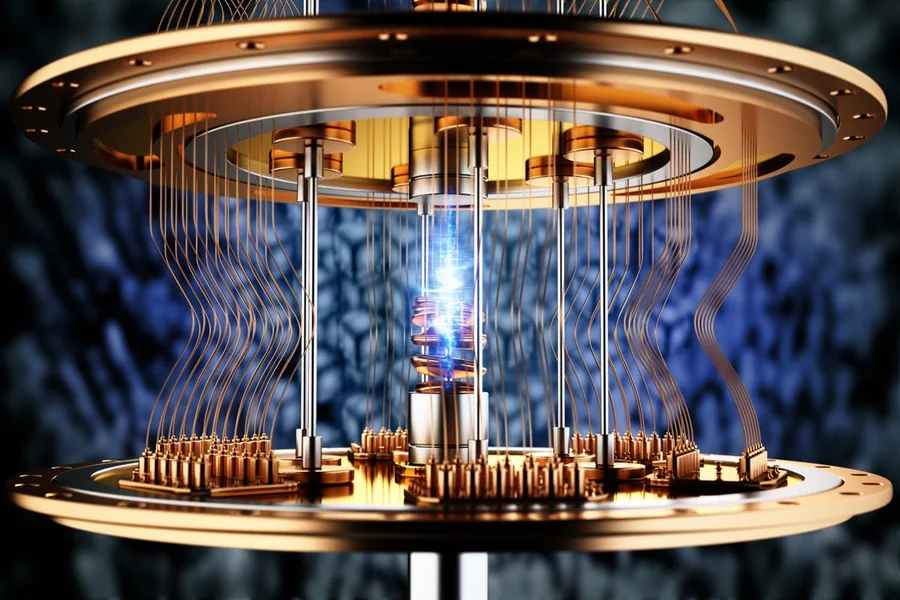
Quantum computing is a type of computing that uses quantum physics to process information instead of the traditional 0s and 1s. The bits used in regular computers are replaced by qubits in quantum computers, which can hold the value of 0, 1, or both simultaneously (this is called superposition). Throw in entanglement, the process of qubits becoming interconnected and affecting one another immediately, and you have a machine capable of simultaneously exploring a multitude of answers. Hence the power of quantum computing in such fields as cryptography, medicine and logistics.
How Is Quantum Computing Different From Regular Computing?
Use what you know first. Your phone, your laptop, pretty much every computer you’ve ever used, is operated by bits. Each bit can either be a 0 or a 1. No in-between, no ambiguity. All of the apps you use and all of the photos you save are these microscopic switches flipping.
Quantum computers are not like that. They employ qubits, and qubits may be in a mixture of 0 and 1 until you measure them. This isn’t a marketing ploy, it’s just the way particles act at that size. Even for those who have been studying it for years, it is weird.
This is a crude illustration of what it would look like. A classical computer sequentially reads a book, page by page. In fact, a quantum computer can ingest multiple pages simultaneously. Not smarter, but that doesn’t stop her from being adorable. It simply means a set of options exists that one could check individually until one found the solution — and that would take too long.
The Core Ideas Behind Quantum Computing
You don’t need a physics degree for this part. Just a little patience.
- Superposition — a qubit can hold a mix of 0 and 1 instead of committing to just one. This is what lets quantum computers process multiple possibilities in parallel.
- Entanglement — link two qubits together, and the state of one affects the other instantly, even across distance. It sounds like science fiction, but it’s been tested and confirmed repeatedly.
- Interference — quantum systems can amplify the paths that lead to correct answers and cancel out the ones that don’t. This is part of what makes a quantum algorithm actually useful, rather than just theoretically interesting.
None of these ideas work well in isolation. Superposition opens up the possibilities, entanglement ties them together, and interference helps the system land on something meaningful. It’s less like a faster calculator and more like a completely different way of approaching a problem.
Why Does Quantum Computing Matter?
Fair question, especially if you’re not a scientist. Here’s the short version: some problems don’t get easier just by adding faster processors. The number of possible solutions grows so quickly that even the best supercomputer on the planet can’t check them all in a reasonable amount of time. Quantum computers are built for exactly that kind of wall.
A few places this could actually change things:
- Drug discovery. Molecules behave according to quantum rules, so simulating them accurately is a natural fit for quantum computers. This could shorten the time it takes to find new treatments.
- Cryptography. A powerful enough quantum computer could break some of the encryption methods we rely on today, which is why researchers are already working on quantum-resistant alternatives.
- Optimization. Airlines, shipping companies, banks — anyone juggling thousands of variables to find the best route, portfolio, or schedule could benefit from quantum algorithms that search more efficiently.
- Materials science. New battery chemistries, stronger alloys, better solar cells — all of it depends on understanding atomic behavior that’s brutally hard to model with classical computers.
To be clear, none of this means quantum computers are about to replace your laptop. They’re not good at browsing the internet or running spreadsheets. They’re specialists, built for a narrow set of problems that happen to be enormously important.
Common Misconceptions About Quantum Computing
Because the topic sounds futuristic, it picks up a lot of myths along the way. Worth clearing a few up.
First one: people assume quantum computers are just faster regular computers. Not true. For most everyday tasks, a classical machine would beat a quantum one without breaking a sweat. Quantum computers only pull ahead on specific problems where their properties actually matter.
Second: a lot of people think this technology is ready for mainstream use right now. It isn’t. Current quantum machines are extremely sensitive — a slight change in temperature or a stray vibration can throw off the whole calculation. Scientists call this decoherence, and it’s one of the biggest obstacles standing between today’s prototypes and a stable, large-scale quantum computer.
Third: quantum computing isn’t a magic wand that instantly solves anything complex. Each application needs its own algorithm, built specifically for that problem. Right now, only a small number of these algorithms show a real, measurable advantage over classical approaches. The rest are still being figured out.
What Does the Future of Quantum Computing Look Like?
Right now, quantum computing sits in an odd spot — somewhere between cutting-edge research and something you’d actually use for work. Companies like IBM and Google keep pushing their hardware further, but we’re still probably years away from quantum computers handling everyday business problems at scale.
The near-term milestone researchers are chasing is called “quantum advantage” — the point where a quantum computer solves a real-world problem faster or more accurately than any classical machine could. A few narrow claims toward this have already been made, though plenty of experts still argue over how significant they really are.
Longer term, the impact could reach further: artificial intelligence, climate modeling, financial forecasting, anything that depends on massive computation. It’s unlikely to replace classical computing outright. More realistically, we’ll end up with a hybrid setup, classical and quantum systems working together, each handling what it’s best at.
Access is opening up too. Several cloud platforms now let developers experiment with actual quantum hardware remotely, no expensive lab required. That’s helping more people get hands-on with the basics, even without a physics background.
Final Thought
Quantum computing sounds intimidating mostly because it breaks rules we’ve trusted since grade school math. Take away the jargon, though, and it’s simply another way to process information, but not using just on-off switches; the weird behavior of particles at the smallest scales.
It’s not necessary to be familiar with superposition or entanglement in order to appreciate the significance of this. The only thing that’s important is that this isn’t science fiction anymore. It’s a truly physical, working field and is slowly making progress towards issues classical computers have been unable to solve for decades.
As it grows up, it will start making waves outside the lab and into applications, including medicine, security and likely some industries that no one has ever thought about. The fundamentals suffice for the moment: qubits are bits, probabilities are certainties, and the concept of what a computer can do is different.